'Before the elections, fake news can create law and order hassles and that is the reason they want social media firms to follow the amended IT Act.'
'Transparency is us watching the government and not the government watching us'

Experts consider Sebi's takeover code in its present form to be on a par with any foreign code governing public mergers and acquisitions.

The apex court's five-judge Constitution bench headed by Chief Justice Dipak Misra said Aadhaar is meant to help benefits reach the marginalised sections of the society and takes into account the dignity of people not only from personal but also from community point of view.

The Aadhaar issuing authority, Unique Identification Authority Of India, has no data on those who have been denied benefits for want of the 12-digit biometric identification number, the Supreme Court was informed on Thursday.

A key argument against the Aadhaar scheme was that it was violative of the nine-judge bench verdict that had held that Right to Privacy is a fundamental right under the Constitution.

A five-judge constitution bench headed by Chief Justice Dipak Misra, hearing a petitions challenging Aadhaar, said no system in the world was secure and the issue was not as to how data is collected, but how the information so collected are used or misused.
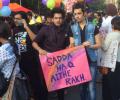
LGBT citizens also enjoy the right to privacy, right to equality and above all, right to life, like any other citizen, writes Sharad Sharma.

Three oil PSUs have moved the Supreme Court seeking modification of its earlier order that Aadhaar card is not mandatory and no person should suffer for want of it in getting benefits of government schemes.

A bench headed by Chief Justice P Sathasivam said that the plea of the Centre would be taken up for hearing on October 8.

Justice Ranjan Gogoi, who will demit office as the Chief Justice of India in a week's time, has etched his name in the annals of history by giving finality to one of the most politically and religiously sensitive cases, the Ayodhya land dispute, which dates back to even before the Supreme Court came into existence in 1950.

Biometric authentication is based on the unscientific and questionable assumption that there are parts of human body that does not age, wither and decay with the passage of time.

Admittedly, EVMs too have a UID number and any convergence of data can make the secret ballot system a party of history, warns Dr Gopal Krishna in the 5th part of his series against Aadhaar.
 © 2026 Rediff.com - Advertise with us - Disclaimer - Privacy Policy - Sitemap - Feedback - About us - Terms of use - Grievances